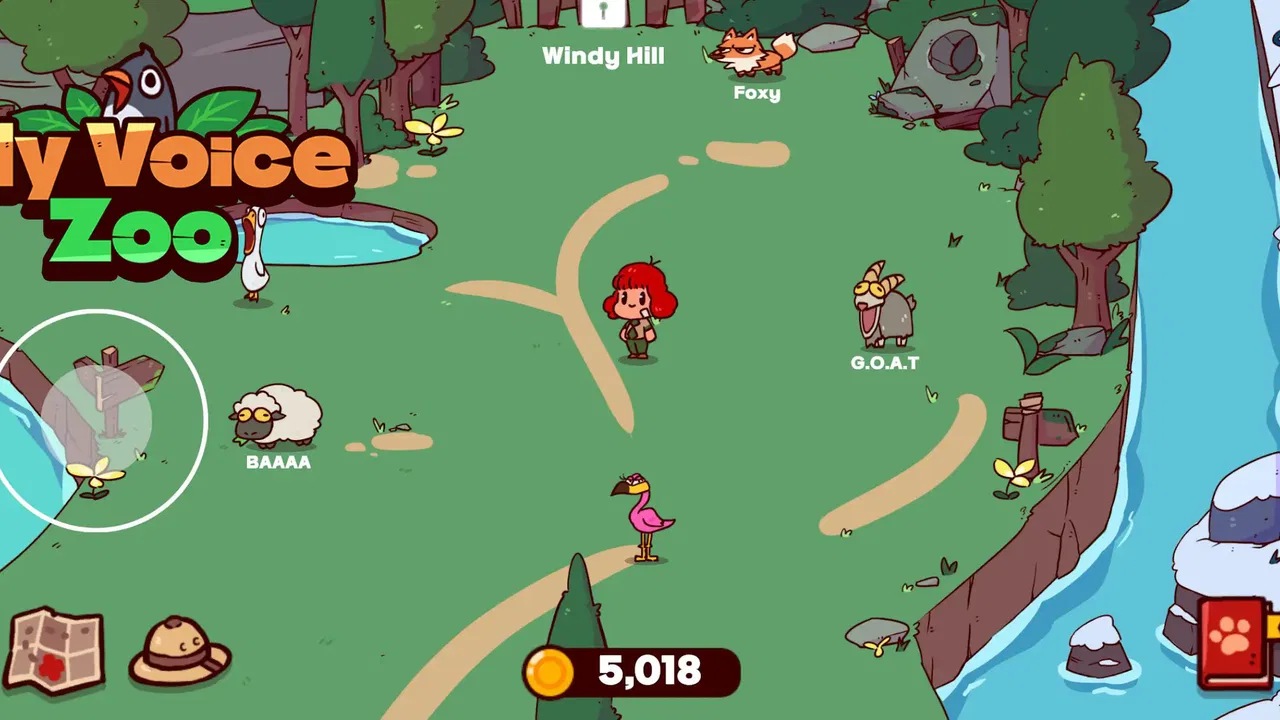
My Voice Zoo: Animal Voice Zoo
- 4.8
- Rating
- 1.00M
- Installs
- Free
- Price

 Analysis by App-foxy
I approached My Voice Zoo: Animal Voice Zoo as a small role-playing game with a very specific promise: your voice is part of the animal experience. That immediately makes it different from the usual collection of fantasy adventures, battle-focused RPGs, and pet simulators. Instead of asking me to master a large rule system, it invites me to experiment with how I sound and to build a personal version of its animal world.
That idea is easy to understand, but deciding whether it is worth installing requires a little more thought. This is not the kind of game I would recommend simply because it belongs to the role-playing category. Its appeal depends on whether you enjoy playful voice interaction, light experimentation, and a game that feels more personal than competitive. If you want a deep campaign, complex character progression, or a long stream of conventional missions, you should set your expectations differently.
After spending time with it, I see the game as a friendly, unusual experience for short sessions. It is free, suitable for Everyone, and developed by 3A BUREAU. The current version is 1.3, and it can run on devices using Android 7.1 or later. Those details make it approachable for a wide range of players, although the real question is not whether it is easy to access. The real question is whether a voice-driven animal game matches the way you like to play.
You May Also Like

 Blood Strike: 2.5 Anniversary
Blood Strike’s Loadouts Turn Every Drop Into a Tactical Gamble
A close look at Blood Strike’s custom loadouts: how fast access to signature weapons reshapes its battle royale rhythm, rewards preparation, and narrows the gap between fights.

 Pandora - Music & Podcasts
Pandora’s Music Is Easy to Start, but Harder to Recover
Pandora’s strength is its low-effort path from a seed to a station. Its weak spot is how much confidence it asks you to place in connection, setup, and quiet recovery.

 8 Ball Pool
 Is Built on Rivalries, Rematches, and Routine
A close look at the rivalries, rematches, shared routines, and unanswered safety questions that turn a quick pool match into a persistent mobile community.

 Samsung Music
’s Quiet Strength Is Playing What You Already Own
Its reach comes less from spectacle than from dependable access to a personal library. That simplicity is both the app’s strongest retention engine and its ceiling.

 AccuWeather: Weather Radar
AccuWeather Review: A Quick, Clear Forecast for Everyday Decisions
For everyday plans, the best forecast is the one you can understand quickly. AccuWeather makes rain timing, radar, and local conditions easy to act on, with a few trade-offs.

 Hill Climb Racing
Why Hill Climb Racing Still Turns Crashes Into One More Run
A tiny car, a bumpy hill and one more upgrade: Hill Climb Racing keeps resurfacing because its simple chaos makes every near-miss feel personal.
More From Our News Desk
View All News


What to consider before choosing a voice-based animal game
The first decision criterion is interaction style. Many role-playing games are built around tapping menus, selecting attacks, upgrading equipment, or reading dialogue. Here, the central attraction is the relationship between the player’s voice and the animals. That changes the mood completely. I found myself paying attention not only to what I was doing on screen, but also to how I was speaking and how much I wanted to participate out loud.
That makes the game a better fit for players who enjoy expressive play than for people who prefer silent, purely visual controls. If you usually play during a commute, in a shared room, or while someone is sleeping nearby, the voice element may be inconvenient. On the other hand, if you want something you can show to a child, a friend, or a family member, the unusual control idea gives it an immediate conversation starter.
The second criterion is depth. I would not choose this game expecting the layered systems found in a traditional role-playing adventure. Its identity comes from the animal-and-voice concept, not from presenting a huge world full of complicated builds. That is not a flaw by itself. A focused idea can be more enjoyable than a bloated game, especially when I only have a few minutes and want something cheerful rather than demanding.
The third criterion is replay value. A voice-centered game can remain entertaining when I try different sounds, tones, and ways of interacting. However, that kind of replay value is personal. One player may enjoy repeating the experiment with different voices, while another may feel that the novelty fades once the basic idea is understood. I would treat the game as a playful experience to revisit, not automatically as an endless main game.
The fourth criterion is audience. The Everyone content rating makes it suitable for a broad audience, and the animal theme is naturally approachable. Still, “suitable for everyone” does not mean everyone will enjoy it equally. Younger players may like the immediate silliness of using their voices, while older players may appreciate it mainly as a relaxed novelty. Players looking for serious narrative role-playing should probably place it lower on their list.
How the voice mechanic changes the experience
The most useful way to approach the game is to treat your voice as a play tool rather than a gimmick you test once. I had more fun when I experimented deliberately: speaking softly, changing my rhythm, trying a playful tone, and seeing how the experience felt from one attempt to the next. That turns a brief interaction into a small personal routine.
A practical tip is to begin in a quiet place and hold the device comfortably rather than trying to play while moving around. Voice interaction is more enjoyable when I can concentrate on the response instead of worrying about background noise or whether other people are listening. If you are introducing the game to a child, it also helps to make the first session collaborative: take turns trying different voices instead of handing over the phone and expecting a long solo session.
Another non-obvious strength is that the game can work as a low-pressure social activity. It does not need to replace a party game to be useful. I can imagine opening it while waiting for food, showing someone the voice idea, and letting them try their own approach. That kind of shared discovery is more important here than chasing a high score or optimizing a character.
Where this game wins over conventional RPGs
The strongest reason to choose this game is its personal, voice-led identity. Standard RPGs usually give me a character to control; this one makes my own voice part of the interaction. That distinction is meaningful for anyone who finds menu-heavy adventures tiring or who wants a game that feels immediately understandable without a long tutorial.
It also wins on approachability. I do not need to learn a large fictional universe before I can enjoy the central idea. The animal theme gives the experience a friendly surface, and the voice interaction provides a clear reason to keep experimenting. For a casual player, that simplicity can be a benefit rather than a limitation.
The game is also a sensible option for short breaks. I would choose it when I want a small burst of interaction instead of committing to a long quest. It is especially suitable for players who like unusual mobile concepts, playful experiments, and games that can be enjoyed with another person watching over their shoulder.
Its rating of 4.8 from around 3.1 thousand ratings suggests that the concept has connected strongly with the people who tried it. I would not treat that average as proof that it replaces every other role-playing game, but it does support my impression that the focused idea is landing well with its intended audience. The game has also passed the 100 thousand install mark, which gives it a meaningful player base for a small, distinctive experience.
Everyday situations where it makes sense
Imagine a parent waiting with a child at a café. The child is bored, but a complicated adventure would take too long to explain. This game offers a quicker entry point: open it, try the voice interaction, and let the child discover what happens. The parent can participate without needing to understand a large set of rules, and the session can end naturally when the wait is over.
I can also see it working for a friend who normally avoids RPGs. Calling it a role-playing game may sound more demanding than it feels, but the animal-and-voice concept lowers the barrier. A person who does not want to manage equipment or read long dialogue may still enjoy trying a few different vocal approaches.
For me, the best solo use is as a reset between more demanding tasks. I would not use it when I need intense challenge, but I might open it after work or during a short break when I want something interactive without a serious commitment. The game’s value is in that gentle change of pace.
Where the usual alternatives may fit better
Traditional role-playing games are the better choice if your priority is a substantial story, strategic combat, character builds, or a sense of long-term progression. Those games usually offer more ways to make decisions and more systems to master. I would choose one of them when I want to feel that every session advances a larger adventure.
Pet simulators may fit better if you mainly want routine care, customization, and a predictable relationship with a digital animal. My Voice Zoo is more interesting when I am actively experimenting with my voice. If your ideal animal game is about feeding, decorating, collecting, or checking in on a pet, a conventional simulator may feel more satisfying.
Party and voice games may be better for a group that wants several players, formal rounds, or clear competition. This game can be shared casually, but I would not assume that it offers the same structure as a dedicated multiplayer party title. Its social strength is spontaneous participation, not necessarily organized group play.
There is also a trade-off with silent mobile games. A puzzle game or standard touch-controlled RPG is easier to play discreetly in public. If you often play in libraries, offices, public transport, or bedrooms at night, the voice requirement may make those alternatives more practical. This is one of the clearest situations where choosing a different category would be sensible.
Small frictions that affect the decision
The biggest friction is not complicated controls; it is the need to feel comfortable using your voice. Some players will enjoy that immediately, while others may feel self-conscious or simply prefer not to speak to their phone. That reaction is personal, but it matters enough that I would make it the first question before installing.
The focused concept may also limit how long the game holds my attention. Once the surprise of voice interaction becomes familiar, continued enjoyment depends on whether I like repeating and refining that interaction. Players who need constant new objectives may find the experience less compelling than a larger RPG.
Another consideration is the difference between novelty and substance. The voice idea gives the game a memorable first impression, but a memorable first impression is not automatically a complete role-playing experience. I enjoyed the personality of the concept, yet I would not recommend it to someone who measures value mainly by campaign length or strategic complexity.
Because it is free, the cost barrier is low. That makes experimentation easy, especially for families or casual players who are unsure about the concept. Still, free access does not remove the cost of switching from another game: you may spend time learning a new style only to discover that voice interaction is not your preference. I would solve that by treating the first session as a quick test rather than making it my main RPG immediately.
How to get a fair first impression
My advice is to test it in three stages. First, play alone somewhere quiet so you can focus on the voice element without feeling watched. Second, repeat the interaction with a few distinct tones instead of using the same voice every time. Third, introduce it to someone else and see whether sharing the idea makes it more enjoyable for you.
This method reveals more than a quick launch-and-close session. It helps answer whether you like the actual interaction or merely like the description of it. It also shows whether the game works better for you as a solo pastime, a family activity, or a novelty to demonstrate once.
I would also avoid comparing it directly with a large RPG during the first few minutes. That comparison is unfair because the games are trying to do different things. Compare it instead with the kind of break you want: if you need a quiet, strategic adventure, choose the conventional RPG; if you want an expressive animal-themed diversion, this game has a clearer advantage.
My recommendation after trying the different use cases
I recommend My Voice Zoo: Animal Voice Zoo to players who want a light, unusual role-playing experience built around speaking and experimenting. It is a particularly good pick for families, casual players, people who enjoy animal themes, and anyone bored by the usual tap-through mobile formula. The free price and broad age rating make it easy to try without turning the decision into a major commitment.
I would skip it if you want a deep story, demanding strategy, silent controls, or a clearly structured long-term adventure. In those cases, a traditional RPG, a pet simulator, or a dedicated party game will probably fit your expectations better. The game should be chosen for its voice-centered personality, not because the role-playing label promises the same depth as every other game in that category.
For my own recommendation, the deciding factor is simple: install it if using your voice sounds like the fun part, not like an obligation. When I approached it with curiosity, the animal concept felt more personal and more memorable than a standard touch-only experience. When I imagined playing silently or looking for a large progression system, its limitations became much clearer.
3A BUREAU has created a focused game with a recognizable hook rather than another interchangeable mobile adventure. That focus is both its main strength and its main boundary. I would keep it as a friendly pick for short sessions and shared moments, while choosing a larger RPG when I want depth. For the right player, that is enough: a free, accessible game that turns an ordinary phone interaction into something playful and distinctly your own.
FAQs for My Voice Zoo: Animal Voice Zoo
01What is My Voice Zoo: Animal Voice Zoo?
My Voice Zoo: Animal Voice Zoo is an interactive educational app designed for children to learn about different animals through their sounds. The app features a variety of animals, each with unique sound clips, and aims to provide an engaging way for kids to explore the animal kingdom.
02Is My Voice Zoo suitable for all ages?
The app is primarily designed for young children, typically aged 3 to 8, offering a safe and educational environment. Its intuitive design and engaging sound effects make it accessible for early learners, though older children might also enjoy the diverse range of animal sounds.
03What are the main features of My Voice Zoo?
My Voice Zoo offers a wide range of animal sounds, interactive touch features, and educational content about each animal. The app includes colorful graphics, easy navigation, and an option for parents to customize learning experiences for their children, enhancing both fun and education.
04Does My Voice Zoo require an internet connection?
No, My Voice Zoo operates offline, making it a great option for travel or areas with limited internet access. Once the app is downloaded, all features are accessible without needing a persistent internet connection, ensuring uninterrupted play and learning.
05Are there any in-app purchases or ads in My Voice Zoo?
My Voice Zoo offers a free version with basic features. To unlock additional content, such as more animals and educational games, there may be optional in-app purchases. The app is designed to be ad-free, allowing children to explore without any interruptions.
Pros
- Fun and engaging for children.
- Wide variety of animal sounds.
- Simple and intuitive interface.
- Educational value for young users.
- No in-app purchases or ads.
Cons
- Limited customization options.
- Lacks offline functionality.
- Repetitive sound effects.
- Graphics are basic and simplistic.
- No multiplayer or social features.

My Voice Zoo: Animal Voice Zoo
Gallery